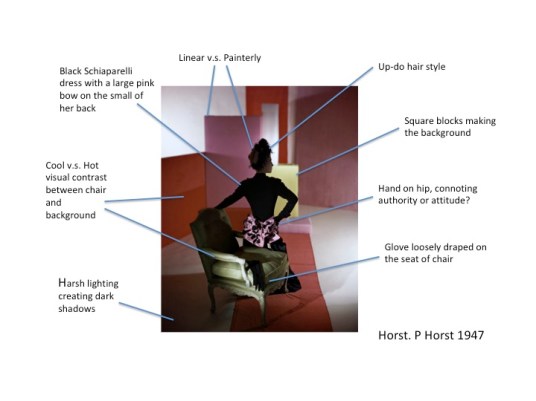
At first glance, this image has three components, a chair, a black silhouette and a colourful backdrop- immediately raising questions as to, why?
The dark silhouette is a woman looking to the right with her right hand resting on her hip, whilst her left hand is leaning on the back of the chair. She has her back to the camera and looks as if she is perching on the chair arm.
The image consists of many visual contrasts, cold tones in the furniture contrasting with the hot reds and pinks of the 3 dimensional cubes creating the background. The painterly silhouette of the woman and delicate detail in the chair contrasts with the linear shapes of the carpet on the floor and the cubes. The harsh lighting has also created deep shadows that contrast with the areas that the light hits. Seemingly, there is a red carpet directing the eye past the subject of the woman and chair, drawing your eye to the layers of squares that is the background. Horst. P Horst has used the Rule of Thirds theory when capturing this image, the focus of the camera has been directed on the subject whilst the background is somewhat out of focus; a shallow depth of field has been used, creating a dream-like, fantastical first impression.
This photograph was for the 15thFebruary 1947 issue of Vogue; it is called Suit and Headdress by Schiaparelli. Schiaparelli is an Italian- born French Fashion designer and is famous for introducing the shade known as ‘shocking pink’. This is reflected significantly in the shoot with the dominant colours being shades of pink, particularly the loud pink bow placed on the woman’s lower back.The structure of the image is orderly with the silhouette placed central, however, the chair is off centre and the background is unsymmetrical, creating a disorderly contrast. The lighting of this image creates an atmospheric illusion. It would appear that the lighting is coming from at least two separate sources creating confusing shadows. For example, the chair leg creates a light shadow whereas the lady’s silhouette creates no shadow following that of the chair; suggesting there is a light in front of her as well as directed at the chair.
It is obvious to me that the two main features that form the image (subject and the background), are from a bygone era. The background suggests that Horst has adopted a Neo-Plasticism feel because of the use of squares and cubes. However, the woman and chair places in the image appear to have come from a French Renaissance era, in turn, creating another interesting visual contrast.
The lady’s face is shaded and it’s hard to distinguish an expression but her head is turned tentatively, combined with her posture of a straight back and hand on hip connotes an authoritative character. With the chair being feminine in terms of the intricate design, combined with the colour palette being predominantly pink and a woman as the subject, there is seemingly little masculinity to this photo. However, the woman is dressed in a dinner suit. Deeper exploration of this brought me to the insight that the 1900’s were the era women started to rebel against the popular culture of women typically wearing dresses. This could have been reflected in the image, having been photographed in the 1940’s. The lady has also taken off her glove in the image, potentially connoting rebellion.
I believe Horst’s intentions lay within trying to create juxtaposition in this image. Styling the model in a dinner suit, historically used as a man’s garment, whilst creating a dark silhouette (in turn, creating a cold appearance) opposes the warmth and femininity of the chosen background colour choices. My interpretation is that this, combined with her strong poise, would suggest that she is rebelling against the ‘norms’ of female identity- an important but often misconstrued theme in surrealist art.
My first impressions of Dinner suit and Headdress were of somewhat confusion and puzzlement as to what the image was trying to express. Upon further analysis I discovered that this image’s narrative is made up entirely of visual contrasts, prompting the viewer to question the meaning behind it. Using contrasting colours and tones, as well as the use of a female dressed in a dinner suit; Horst has successfully told a story of the social conflicts occurring in that era, with focus on blurring the gender stereotypes. Horst has adopted a surrealist feel to the image by combining the Neo-Plasticism movement with the Renaissance era, and combined with the use obscure lighting and blurred background; it creates, to me, an almost fantastical/mystical narrative.
 KIRSTY BROWN